
Welcome to Good Market Info! Click the logo to go to the Good Market Commons
Good Market Info > Digital Commons
Commons are shared resources governed by a community according to agreed rules for long-term collective benefit.
Good Market is a digital commons created by and for social enterprises, cooperatives, responsible businesses, networks, community initiatives, and changemakers. The commons includes a free curation process and shared infrastructure.
The directory and marketplaces are publicly accessible to visitors, but other shared resources are limited to Good Market Approved enterprises and networks that prioritize people and planet over profit and meet the minimum sector standards.
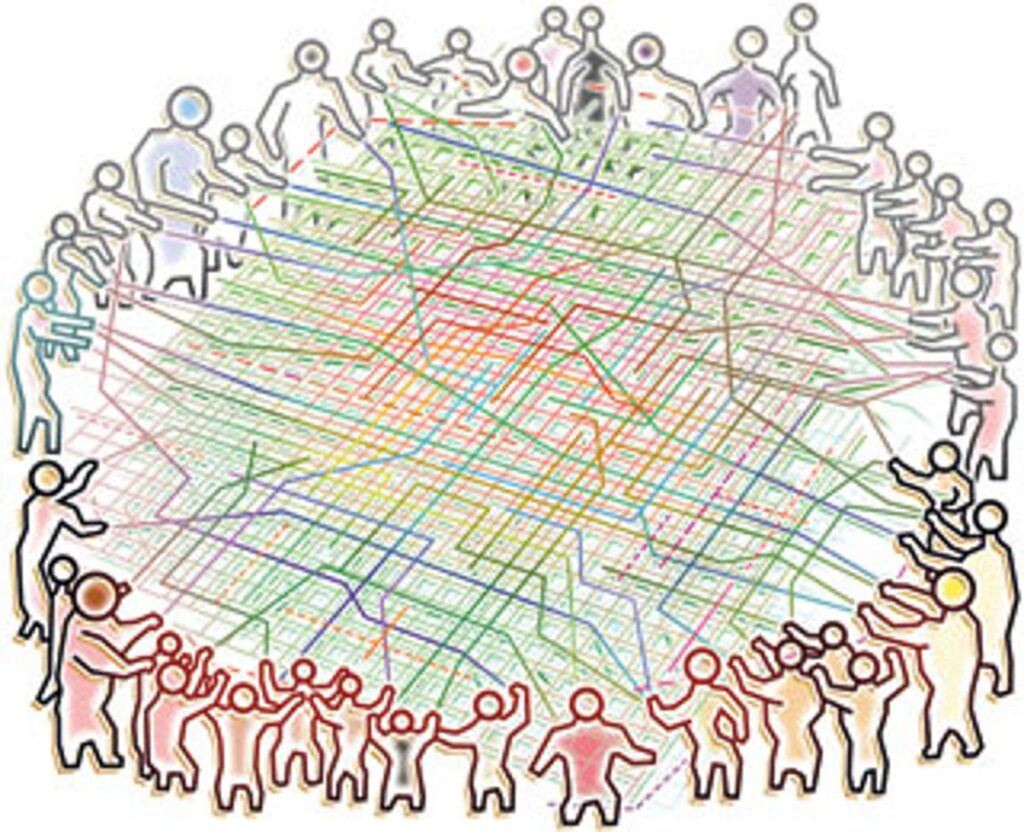
The digital commons has a free curation process that works across economic sectors, income levels, language barriers, and regional divides. This makes it possible to include initiatives that benefit people and the planet but aren’t able to afford social and environmental certifications
The curation process provides a clear boundary that helps build trust and community ownership. It includes minimum sector standards, a dynamic application form, public profiles, a crowdsourced monitoring system, and polycentric governance.
The process was developed and tested through four years of weekly in-person meetings, more than 1,000 paper applications in three languages, and more than 100 instances of offline “flagging.” It has been online since late 2016.
A sector in an economic system is like a niche in an ecological system. Good Market sectors are based on (and can be mapped to) the United Nations International Standard Industrial Classification (ISIC), but they have been adapted to reflect the emerging economy.
The minimum sector standards were developed by reviewing more than 200 social and environmental certifications, aggregating best practices for different sectors, and translating them into everyday language. They are updated and improved over time based on participant feedback.
The application form is dynamic, which means questions appear depending on which sector is selected and how previous questions are answered. It is based on the understanding that every enterprise is different. Applicants are encouraged to use the form to share their purpose and story and select No if a question doesn’t apply.
The review process is tech-enabled, but each application is checked by a human. Applicants are never rejected. More Info applicants are requested to submit clarifications or additional supporting information. Not Approved applicants are given a list of points to work on and encouraged to reapply in the future when they meet minimum sector standards.
When applicants select an answer, they are making a claim about their work. If they are approved, their claims are shared publicly in the People & Planet section of their profile page. Approved enterprises can update their profile page as their information changes and their work evolves.
The curation process is designed to function across languages. Applicants can submit the form in their preferred language, and their public profile claims can be viewed in a different language.
If a customer, worker, supplier, or anyone else has evidence of a false claim or evidence that an enterprise no longer meets minimum sector standards, they can flag a profile anonymously by clicking the flag icon, selecting the false claim, and submitting their evidence. Flagging starts a review process.
The review process can result in the flagged enterprise improving their communication, updating their claims, taking corrective action, or losing their status as Good Market Approved and being removed from the directory.
Good Market was designed to support community groups and networks that have emerged around different sectors, issues, and regions.
The minimum sector standards and “primary” curation process provide a common baseline for all participants. Community groups and networks may have additional standards and their own curation, membership, verification, or certification process. They use their network page on the digital commons to show enterprises that meet their additional criteria.
Shared software and services help Good Market participants avoid information silos, reduce administrative burdens and technology costs, and focus resources on their core purpose.
This approach is enabled by collective development, a protected structure, and a commitment to digital inclusion, and interoperability.
Most participants do not have the resources for custom software development, integrations, back-up systems, security, maintenance, updates, and support services. Collaborating on infrastructure makes it possible to share costs, benefit from not-for-profit discounts, and use self-hosted open source tools.
The core software roadmap prioritizes functionality that benefits all participants. If a Good Market Approved enterprise or network has a specific software requirement that’s in alignment with the digital commons, they can mobilize resources to invest in new functionality. This new software functionality is available to everyone who uses the site. Other participants can build on top of that functionality and invest in additional improvements over time.
Enterprises retain control over their own information and update it as needed. They can submit the application form once and access services and opportunities from multiple networks. They can create listings once and have them appear in multiple network marketplaces. They can participate in multiple surveys without having to re-enter the same information multiple times.
Participants help document bugs and recommend improvements because the digital commons is a collective resource.
The digital commons started in Sri Lanka. Before it expanded globally, it was tested and used by Sinhala and Tamil speakers with no computer access and limited data plans, connectivity, and digital literacy. It was developed as a progressive web app (PWA) to work across devices, minimize download requirements, reduce reliance on proprietary app stores, and contribute to the open web. Mobile-first design and community translation were integrated from the beginning.
The support team specializes in assisting people who don’t speak English, aren’t comfortable with tech, have outdated devices and browsers, and live in rural areas with weak internet connections. The finance team has experience with foreign exchange restrictions and works with enterprises to find payment and payout solutions for their local context.
The digital commons operates under a not-for-profit structure with a self-sustaining revenue model to protect the purpose over time. There are no private owners, extractive investors, or restrictive donors to influence decision-making. Infrastructure development is based on collective benefit.
When platforms are under pressure to extract ever-increasing profits, they try to prevent direct connections between users because they need all transactions to happen through their closed system. The digital commons encourages direct connection and supports off-platform trade because the focus is on strengthening relationships and building next economy enterprises.
Similarly, platforms dependent on advertising develop algorithms to maximize engagement and extract attention. Enterprises that join a platform early may be able to build a large following with significant reach, but as the platform becomes “enshittified,” they are only able to reach their followers and maintain visibility through high-frequency posting and paid ads. The digital commons supports intentional technology use, less screentime, and more human connection. Participants share when they have something to offer and search when they have something they need.
Since the purpose of the digital commons is to benefit participants and the overall collective, there is a strong focus on interoperability and integrations with other platforms and tools. The goal is to transition to an open protocol that enables participants to share their information across platforms.
Enterprises and networks can request and fund integrations for their own data. This has included integrations with email marketing and customer relationship management (CRM) platforms, supplier data sites, online stores, marketplaces, and procurement platforms.
For core infrastructure, the priority is open source, not-for-profit, and mission-locked technology. The digital commons uses Matrix for chat and groups, Medusa for listings and marketplace functionality, Plausible for GDPR-compliant web analytics, and Metabase for data analytics.